Poetry (from the Greek 'poiesis'/ποίησις [poieo/ποιέω], a making: forming, creating, or the art of poetry, or a poem) is a form of literary art in which language is used for its aesthetic and evocative qualities in addition to, or in lieu of, its apparent meaning.
Poetry has a
long history, dating back to the Sumerian Epic of Gilgamesh. The earliest poems
evolved from folk songs, such as the Chinese Shijing, or from the need to
retell oral epics, such as the Sanskrit Vedas, Zoroastrian Gathas, and the
Homeric epics, the Odyssey and the Iliad. Ancient attempts to define poetry,
such as Aristotle's Poetics, focused on the uses of speech in rhetoric, drama,
song, and comedy. Later attempts concentrated on features such as repetition,
verse form and rhyme, and emphasized the aesthetics which distinguish poetry
from more objectively informative, prosaic forms of writing. From the mid-20th
century, poetry has sometimes been more generally labelled as a fundamental
creative act using language.
Poetry
primarily is governed by idiosyncratic forms and conventions to suggest
differential interpretation to words, or to evoke emotive responses. Devices
such as assonance, alliteration, onomatopoeia, and rhythm are sometimes used to
achieve musical or incantatory effects. The use of ambiguity, symbolism, irony,
and other stylistic elements of poetic diction often leaves a poem open to
multiple interpretations. Similarly, metaphor, simile, and metonymy create a
resonance between otherwise disparate images—a layering of meanings, forming
connections previously not perceived. Kindred forms of resonance may exist,
between individual verses, in their patterns of rhyme or rhythm.
Some poetry
types are specific to particular cultures and genres, responding to the
characteristics of the language in which the poet writes. Readers accustomed to
identifying poetry with Dante, Goethe, Mickiewicz and Rumi may think of it as
being written in lines based upon rhyme and regular meter; however, there are
traditions, such as Biblical poetry, that use other methodologies to create
rhythm and euphony. Much of modern British and American poetry is to some
extent a critique of poetic tradition, playing with and testing (among other
things) the principle of euphony itself, to the extent that sometimes it
deliberately does not rhyme or keep to set rhythms at all. In today's
globalized world poets often borrow styles, techniques and forms from diverse
cultures and languages.
History
 |
| Aristotle |
Poetry as an
art form may predate literacy. Epic poetry, from the Indian Vedas (1700–1200
BC) and Zoroaster's Gathas to the Odyssey (800–675 BC), appears to have been
composed in poetic form to aid memorization and oral transmission, in prehistoric
and ancient societies. Other forms of poetry developed directly from folk
songs. The earliest entries in the ancient compilation Shijing (1000 BC), were
initially lyrics, preceding later entries intended to be read.
The oldest
surviving epic poem is the Epic of Gilgamesh, from the 3rd millennium BC in
Sumer (in Mesopotamia, now Iraq), which was written in cuneiform script on clay
tablets and, later, papyrus. Other ancient epic poetry includes the Greek
epics Iliad and Odyssey, the Old Iranian books the Gathic Avesta and Yasna, the
Roman national epic, Virgil's Aeneid, and the Indian epics Ramayana and
Mahabharata.
The efforts
of ancient thinkers to determine what makes poetry distinctive as a form, and
what distinguishes good poetry from bad, resulted in "poetics"—the
study of the aesthetics of poetry.[9] Some ancient societies, such as the
Chinese through the Shijing (Classic of Poetry), developed canons of poetic
works that had ritual as well as aesthetic importance. More recently, thinkers
have struggled to find a definition that could encompass formal differences as
great as those between Chaucer's Canterbury Tales and Matsuo Bashō's Oku no
Hosomichi, as well as differences in context spanning Tanakh religious poetry,
love poetry, and rap.
Western
traditions
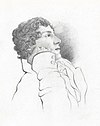 |
| John Keats |
Classical
thinkers employed classification as a way to define and assess the quality of
poetry. Notably, the existing fragments of Aristotle's Poetics describe three
genres of poetry—the epic, the comic, and the tragic—and develop rules to
distinguish the highest-quality poetry in each genre, based on the underlying
purposes of the genre. Later aestheticians identified three major genres: epic
poetry, lyric poetry, and dramatic poetry, treating comedy and tragedy as
subgenres of dramatic poetry.
Aristotle's
work was influential throughout the Middle East during the Islamic Golden Age,
as well as in Europe during the Renaissance. Later poets and aestheticians
often distinguished poetry from, and defined it in opposition to prose, which
was generally understood as writing with a proclivity to logical explication and
a linear narrative structure.
This does not
imply that poetry is illogical or lacks narration, but rather that poetry is an
attempt to render the beautiful or sublime without the burden of engaging the
logical or narrative thought process. English Romantic poet John Keats termed
this escape from logic "Negative Capability". This
"romantic" approach views form as a key element of successful poetry
because form is abstract and distinct from the underlying notional logic. This
approach remained influential into the 20th century.
During this
period, there was also substantially more interaction among the various poetic
traditions, in part due to the spread of European colonialism and the attendant
rise in global trade. In addition to a boom in translation, during the Romantic
period numerous ancient works were rediscovered.
20th-Century
Disputes
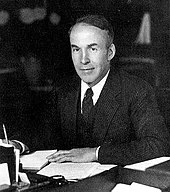 |
| Archibald MacLeish |
Some
20th-century literary theorists, relying less on the opposition of prose and
poetry, focused on the poet as simply one who creates using language, and
poetry as what the poet creates.[21] The underlying concept of the poet as
creator is not uncommon, and some modernist poets essentially do not
distinguish between the creation of a poem with words, and creative acts in
other media. Yet other modernists challenge the very attempt to define poetry
as misguided.
The rejection
of traditional forms and structures for poetry that began in the first half of
the 20th century coincided with a questioning of the purpose and meaning of
traditional definitions of poetry and of distinctions between poetry and prose,
particularly given examples of poetic prose and prosaic poetry. Numerous
modernist poets have written in non-traditional forms or in what traditionally
would have been considered prose, although their writing was generally infused
with poetic diction and often with rhythm and tone established by non-metrical
means. While there was a substantial formalist reaction within the modernist
schools to the breakdown of structure, this reaction focused as much on the
development of new formal structures and syntheses as on the revival of older
forms and structures.
Recently,
postmodernism has come to convey more completely prose and poetry as distinct
entities, and also among genres of poetry, as having meaning only as cultural
artifacts. Postmodernism goes beyond modernism's emphasis on the creative role
of the poet, to emphasize the role of the reader of a text (Hermeneutics), and
to highlight the complex cultural web within which a poem is read. Today,
throughout the world, poetry often incorporates poetic form and diction from
other cultures and from the past, further confounding attempts at definition
and classification that were once sensible within a tradition such as the
Western canon.
Elements
Prosody
Prosody is
the study of the meter, rhythm, and intonation of a poem. Rhythm and meter are
different, although closely related. Meter is the definitive pattern
established for a verse (such as iambic pentameter), while rhythm is the actual
sound that results from a line of poetry. Prosody also may be used more
specifically to refer to the scanning of poetic lines to show meter.
Rhythm
 |
| Robinson Jeffers |
The methods
for creating poetic rhythm vary across languages and between poetic traditions.
Languages are often described as having timing set primarily by accents,
syllables, or moras, depending on how rhythm is established, though a language
can be influenced by multiple approaches. Japanese is a mora-timed language.
Syllable-timed languages include Latin, Catalan, French, Leonese, Galician and
Spanish. English, Russian and, generally, German are stress-timed languages.
Varying intonation also affects how rhythm is perceived. Languages can rely on
either pitch, such as in Vedic Sanskrit or Ancient Greek, or tone. Tonal
languages include Chinese, Vietnamese, Lithuanian, and most Subsaharan
languages.
Metrical
rhythm generally involves precise arrangements of stresses or syllables into
repeated patterns called feet within a line. In Modern English verse the
pattern of stresses primarily differentiate feet, so rhythm based on meter in
Modern English is most often founded on the pattern of stressed and unstressed
syllables (alone or elided). In the classical languages, on the other hand,
while the metrical units are similar, vowel length rather than stresses define
the meter. Old English poetry used a metrical pattern involving varied numbers
of syllables but a fixed number of strong stresses in each line.
The chief
device of ancient Hebrew Biblical poetry, including many of the psalms, was
parallelism, a rhetorical structure in which successive lines reflected each
other in grammatical structure, sound structure, notional content, or all
three. Parallelism lent itself to antiphonal or call-and-response performance,
which could also be reinforced by intonation. Thus, Biblical poetry relies much
less on metrical feet to create rhythm, but instead creates rhythm based on
much larger sound units of lines, phrases and sentences. Some classical poetry
forms, such as Venpa of the Tamil language, had rigid grammars (to the point
that they could be expressed as a context-free grammar) which ensured a rhythm.
In Chinese poetry, tones as well as stresses create rhythm. Classical Chinese
poetics identifies four tones: the level tone, rising tone, departing tone, and
entering tone.
The formal
patterns of meter used in Modern English verse to create rhythm no longer
dominate contemporary English poetry. In the case of free verse, rhythm is
often organized based on looser units of cadence rather than a regular meter.
Robinson Jeffers, Marianne Moore, and William Carlos Williams are three notable
poets who reject the idea that regular accentual meter is critical to English
poetry.[36] Jeffers experimented with sprung rhythm as an alternative to
accentual rhythm.[37]
Meter
In the
Western poetic tradition, meters are customarily grouped according to a
characteristic metrical foot and the number of feet per line. The number of
metrical feet in a line are described using Greek terminology: tetrameter for
four feet and hexameter for six feet, for example. Thus, "iambic pentameter"
is a meter comprising five feet per line, in which the predominant kind of foot
is the "iamb". This metric system originated in ancient Greek poetry,
and was used by poets such as Pindar and Sappho, and by the great tragedians of
Athens. Similarly, "dactylic hexameter", comprises six feet per line,
of which the dominant kind of foot is the "dactyl". Dactylic
hexameter was the traditional meter of Greek epic poetry, the earliest extant
examples of which are the works of Homer and Hesiod. Iambic pentameter and
dactylic hexameter were later used by a number of poets, including William
Shakespeare and Henry Wadsworth Longfellow, respectively. The most common
metrical feet in English are:
 |
| Homer |
- iamb – one unstressed syllable followed by a stressed syllable (e.g. describe, Include, retract)
- trochee – one stressed syllable followed by an unstressed syllable (e.g. picture, flower)
- dactyl – one stressed syllable followed by two unstressed syllables (e.g.annotate an-no-tate)
- anapest – two unstressed syllables followed by one stressed syllable (e.g. comprehend com-pre-hend)
- spondee – two stressed syllables together (e.g. e-nough)
- pyrrhic – two unstressed syllables together (rare, usually used to end dactylic hexameter)
There are a
wide range of names for other types of feet, right up to a choriamb, a four
syllable metric foot with a stressed syllable followed by two unstressed
syllables and closing with a stressed syllable. The choriamb is derived from
some ancient Greek and Latin poetry.[40] Languages which utilize vowel length
or intonation rather than or in addition to syllabic accents in determining
meter, such as Ottoman Turkish or Vedic, often have concepts similar to the
iamb and dactyl to describe common combinations of long and short sounds.
Each of these
types of feet has a certain "feel," whether alone or in combination
with other feet. The iamb, for example, is the most natural form of rhythm in
the English language, and generally produces a subtle but stable verse.
Scanning meter can often show the basic or fundamental pattern underlying a
verse, but does not show the varying degrees of stress, as well as the
differing pitches and lengths of syllables.
 |
| A Holiday illustration to Carroll's "The Hunting of the Snark", which is written mainly in anapestic tetrameter. |
There is
debate over how useful a multiplicity of different "feet" is in
describing meter. For example, Robert Pinsky has argued that while dactyls are
important in classical verse, English dactylic verse uses dactyls very
irregularly and can be better described based on patterns of iambs and
anapests, feet which he considers natural to the language. Actual rhythm is
significantly more complex than the basic scanned meter described above, and
many scholars have sought to develop systems that would scan such complexity.
Vladimir Nabokov noted that overlaid on top of the regular pattern of stressed
and unstressed syllables in a line of verse was a separate pattern of accents
resulting from the natural pitch of the spoken words, and suggested that the
term "scud" be used to distinguish an unaccented stress from an
accented stress.
Metrical
Patterns
Different
traditions and genres of poetry tend to use different meters, ranging from the
Shakespearean iambic pentameter and the Homeric dactylic hexameter to the
anapestic tetrameter used in many nursery rhymes. However, a number of
variations to the established meter are common, both to provide emphasis or
attention to a given foot or line and to avoid boring repetition. For example,
the stress in a foot may be inverted, a caesura (or pause) may be added
(sometimes in place of a foot or stress), or the final foot in a line may be
given a feminine ending to soften it or be replaced by a spondee to emphasize
it and create a hard stop. Some patterns (such as iambic pentameter) tend to be
fairly regular, while other patterns, such as dactylic hexameter, tend to be
highly irregular. Regularity can vary between language. In addition, different
patterns often develop distinctively in different languages, so that, for
example, iambic tetrameter in Russian will generally reflect a regularity in
the use of accents to reinforce the meter, which does not occur, or occurs to a
much lesser extent, in English.
 |
| Alexander Pushkin |
Some common
metrical patterns, with notable examples of poets and poems who use them,
include:
- Iambic pentameter (John Milton in Paradise Lost, William Shakespeare in his Sonnets)
- Dactylic hexameter (Homer, Iliad; Virgil, Aeneid)
- Iambic tetrameter (Andrew Marvell, "To His Coy Mistress"; Aleksandr Pushkin, Eugene Onegin, Robert Frost, Stopping by Woods on a Snowy Evening)
- Trochaic octameter (Edgar Allan Poe, "The Raven")
- Alexandrine (Jean Racine, Phèdre)
 |
| The Old English epic poem Beowulf is written in alliterative verse and paragraphs, not in lines or stanzas. |
Rhyme,
alliteration, assonance and consonance are ways of creating repetitive patterns
of sound. They may be used as an independent structural element in a poem, to
reinforce rhythmic patterns, or as an ornamental element. They can also carry a
meaning separate from the repetitive sound patterns created. For example,
Chaucer used heavy alliteration to mock Old English verse and to paint a
character as archaic.
Rhyme
consists of identical ("hard-rhyme") or similar
("soft-rhyme") sounds placed at the ends of lines or at predictable
locations within lines ("internal rhyme"). Languages vary in the
richness of their rhyming structures; Italian, for example, has a rich rhyming
structure permitting maintenance of a limited set of rhymes throughout a
lengthy poem. The richness results from word endings that follow regular forms.
English, with its irregular word endings adopted from other languages, is less
rich in rhyme. The degree of richness of a language's rhyming structures plays
a substantial role in determining what poetic forms are commonly used in that
language.
Alliteration
and assonance played a key role in structuring early Germanic, Norse and Old
English forms of poetry. The alliterative patterns of early Germanic poetry
interweave meter and alliteration as a key part of their structure, so that the
metrical pattern determines when the listener expects instances of alliteration
to occur. This can be compared to an ornamental use of alliteration in most
Modern European poetry, where alliterative patterns are not formal or carried
through full stanzas. Alliteration is particularly useful in languages with
less rich rhyming structures. Assonance, where the use of similar vowel sounds
within a word rather than similar sounds at the beginning or end of a word, was
widely used in skaldic poetry, but goes back to the Homeric epic. Because verbs
carry much of the pitch in the English language, assonance can loosely evoke
the tonal elements of Chinese poetry and so is useful in translating Chinese poetry.
Consonance occurs where a consonant sound is repeated throughout a sentence without
putting the sound only at the front of a word. Consonance provokes a more
subtle effect than alliteration and so is less useful as a structural element.
Rhyming
Schemes
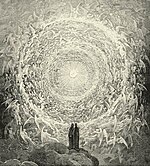 |
| Dante and Beatrice see God as a point of light surrounded by angels. A Doré illustration to the Divine Comedy, Paradiso, Canto 28. |
In many
languages, including modern European languages and Arabic, poets use rhyme in
set patterns as a structural element for specific poetic forms, such as
ballads, sonnets and rhyming couplets. However, the use of structural rhyme is
not universal even within the European tradition. Much modern poetry avoids
traditional rhyme schemes. Classical Greek and Latin poetry did not use rhyme.
Rhyme entered European poetry in the High Middle Ages, in part under the
influence of the Arabic language in Al Andalus (modern Spain). Arabic language
poets used rhyme extensively from the first development of literary Arabic in
the sixth century, as in their long, rhyming qasidas. Some rhyming schemes have
become associated with a specific language, culture or period, while other
rhyming schemes have achieved use across languages, cultures or time periods.
Some forms of poetry carry a consistent and well-defined rhyming scheme, such
as the chant royal or the rubaiyat, while other poetic forms have variable
rhyme schemes.
Most rhyme
schemes are described using letters that correspond to sets of rhymes, so if
the first, second and fourth lines of a quatrain rhyme with each other and the
third line does not rhyme, the quatrain is said to have an "a-a-b-a"
rhyme scheme. This rhyme scheme is the one used, for example, in the rubaiyat
form.[65] Similarly, an "a-b-b-a" quatrain (what is known as
"enclosed rhyme") is used in such forms as the Petrarchan sonnet.[66]
Some types of more complicated rhyming schemes have developed names of their
own, separate from the "a-b-c" convention, such as the ottava rima
and terza rima.[67] The types and use of differing rhyming schemes is discussed
further in the main article.
Form
Poetic form
is more flexible in modernist and post-modernist poetry, and continues to be
less structured than in previous literary eras. Many modern poets eschew
recognisable structures or forms, and write in free verse. But poetry remains
distinguished from prose by its form; some regard for basic formal structures
of poetry will be found in even the best free verse, however much such
structures may appear to have been ignored. Similarly, in the best poetry
written in classic styles there will be departures from strict form for
emphasis or effect.
Among major
structural elements used in poetry are the line, the stanza or verse paragraph,
and larger combinations of stanzas or lines such as cantos. Also sometimes used
are broader visual presentations of words and calligraphy. These basic units of
poetic form are often combined into larger structures, called poetic forms or
poetic modes (see following section), as in the sonnet or haiku.
Lines and
Stanzas
Poetry is
often separated into lines on a page. These lines may be based on the number of
metrical feet, or may emphasize a rhyming pattern at the ends of lines. Lines
may serve other functions, particularly where the poem is not written in a
formal metrical pattern. Lines can separate, compare or contrast thoughts
expressed in different units, or can highlight a change in tone.[70] See the
article on line breaks for information about the division between lines.
Lines of
poems are often organized into stanzas, which are denominated by the number of
lines included. Thus a collection of two lines is a couplet (or distich), three
lines a triplet (or tercet), four lines a quatrain, and so on. These lines may
or may not relate to each other by rhyme or rhythm. For example, a couplet may
be two lines with identical meters which rhyme or two lines held together by a
common meter alone.
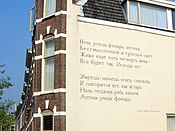 |
| Alexander Blok's poem, "Noch, ulitsa, fonar, apteka" ("Night, street, lamp, drugstore"), on a wall in Leiden |
Other poems
may be organized into verse paragraphs, in which regular rhymes with
established rhythms are not used, but the poetic tone is instead established by
a collection of rhythms, alliterations, and rhymes established in paragraph
form. Many medieval poems were written in verse paragraphs, even where regular
rhymes and rhythms were used.
In many forms
of poetry, stanzas are interlocking, so that the rhyming scheme or other
structural elements of one stanza determine those of succeeding stanzas.
Examples of such interlocking stanzas include, for example, the ghazal and the
villanelle, where a refrain (or, in the case of the villanelle, refrains) is
established in the first stanza which then repeats in subsequent stanzas.
Related to the use of interlocking stanzas is their use to separate thematic
parts of a poem. For example, the strophe, antistrophe and epode of the ode
form are often separated into one or more stanzas.
In some
cases, particularly lengthier formal poetry such as some forms of epic poetry,
stanzas themselves are constructed according to strict rules and then combined.
In skaldic poetry, the dróttkvætt stanza had eight lines, each having three
"lifts" produced with alliteration or assonance. In addition to two
or three alliterations, the odd numbered lines had partial rhyme of consonants
with dissimilar vowels, not necessarily at the beginning of the word; the even
lines contained internal rhyme in set syllables (not necessarily at the end of
the word). Each half-line had exactly six syllables, and each line ended in a
trochee. The arrangement of dróttkvætts followed far less rigid rules than the
construction of the individual dróttkvætts.
Visual
Presentation
 |
| Arabic Poetry |
Even before
the advent of printing, the visual appearance of poetry often added meaning or
depth. Acrostic poems conveyed meanings in the initial letters of lines or in
letters at other specific places in a poem.[76] In Arabic, Hebrew and Chinese
poetry, the visual presentation of finely calligraphed poems has played an
important part in the overall effect of many poems.
With the
advent of printing, poets gained greater control over the mass-produced visual
presentations of their work. Visual elements have become an important part of
the poet's toolbox, and many poets have sought to use visual presentation for a
wide range of purposes. Some Modernist poets have made the placement of
individual lines or groups of lines on the page an integral part of the poem's
composition. At times, this complements the poem's rhythm through visual
caesuras of various lengths, or creates juxtapositions so as to accentuate
meaning, ambiguity or irony, or simply to create an aesthetically pleasing
form. In its most extreme form, this can lead to concrete poetry or asemic
writing.
Diction
Poetic
diction treats the manner in which language is used, and refers not only to the
sound but also to the underlying meaning and its interaction with sound and
form.[80] Many languages and poetic forms have very specific poetic dictions,
to the point where distinct grammars and dialects are used specifically for
poetry.[81][82] Registers in poetry can range from strict employment of
ordinary speech patterns, as favoured in much late 20th-century prosody,[83]
through to highly ornate uses of language, as in medieval and Renaissance
poetry.
Poetic
diction can include rhetorical devices such as simile and metaphor, as well as
tones of voice, such as irony. Aristotle wrote in the Poetics that "the
greatest thing by far is to be a master of metaphor."[85] Since the rise
of Modernism, some poets have opted for a poetic diction that de-emphasizes
rhetorical devices, attempting instead the direct presentation of things and
experiences and the exploration of tone.[86] On the other hand, Surrealists
have pushed rhetorical devices to their limits, making frequent use of
catachresis.
Allegorical
stories are central to the poetic diction of many cultures, and were prominent
in the West during classical times, the late Middle Ages and the Renaissance.
Aesop's Fables, repeatedly rendered in both verse and prose since first being
recorded about 500 B.C., are perhaps the richest single source of allegorical
poetry through the ages.[88] Other notables examples include the Roman de la Rose,
a 13th-century French poem, William Langland's Piers Ploughman in the 14th
century, and Jean de la Fontaine's Fables (influenced by Aesop's) in the 17th
century. Rather than being fully allegorical, however, a poem may contain
symbols or allusions that deepen the meaning or effect of its words without constructing
a full allegory.
Another
strong element of poetic diction can be the use of vivid imagery for effect.
The juxtaposition of unexpected or impossible images is, for example, a
particularly strong element in surrealist poetry and haiku. Vivid images are
often endowed with symbolism or metaphor. Many poetic dictions use repetitive
phrases for effect, either a short phrase (such as Homer's "rosy-fingered
dawn" or "the wine-dark sea") or a longer refrain. Such
repetition can add a sombre tone to a poem, or can be laced with irony as the
context of the words changes.
Forms
Specific
poetic forms have been developed by many cultures. In more developed, closed or
"received" poetic forms, the rhyming scheme, meter and other elements
of a poem are based on sets of rules, ranging from the relatively loose rules
that govern the construction of an elegy to the highly formalized structure of
the ghazal or villanelle.[92] Described below are some common forms of poetry
widely used across a number of languages. Additional forms of poetry may be
found in the discussions of poetry of particular cultures or periods and in the
glossary.
Sonnet
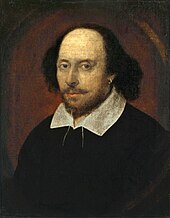 |
| Shakespeare |
Among the
most common forms of poetry through the ages is the sonnet, which by the 13th
century was a poem of fourteen lines following a set rhyme scheme and logical
structure. By the 14th century, the form further crystallized under the pen of
Petrarch, whose sonnets were later translated in the 16th century by Sir Thomas
Wyatt, who is credited with introducing the sonnet form into English
literature. A sonnet's first four lines typically introduce the topic. A sonnet
usually follows an a-b-a-b rhyme pattern. The sonnet's conventions have changed
over its history, and so there are several different sonnet forms.
Traditionally, in sonnets English poets use iambic pentameter, the Spenserian
and Shakespearean sonnets being especially notable. In the Romance languages,
the hendecasyllable and Alexandrine are the most widely used meters, though the
Petrarchan sonnet has been used in Italy since the 14th century.
Sonnets are
particularly associated with love poetry, and often use a poetic diction
heavily based on vivid imagery, but the twists and turns associated with the
move from octave to sestet and to final couplet make them a useful and dynamic
form for many subjects. Shakespeare's sonnets are among the most famous in
English poetry, with 20 being included in the Oxford Book of English Verse.
Jintishi
The jintishi
(近體詩) is a formal type of Classical
Chinese poetry, based on a set of fixed rules. These include the use of set
patterns using the four tones of Middle Chinese in each couplet: the level,
rising, departing and entering tones. There are several variations on the form
of the jintishi. The basic form has eight lines in four couplets, with
parallelism between the lines in the second and third couplets. The couplets
with parallel lines contain contrasting content but an identical grammatical
relationship between words. Jintishi often have a rich poetic diction, full of
allusion, and can have a wide range of subject, including history and politics.
One of the masters of the form was Du Fu, who wrote during the Tang Dynasty
(8th century).
Villanelle
 |
| W. H. Auden |
The
villanelle is a nineteen-line poem made up of five triplets with a closing
quatrain; the poem is characterized by having two refrains, initially used in
the first and third lines of the first stanza, and then alternately used at the
close of each subsequent stanza until the final quatrain, which is concluded by
the two refrains. The remaining lines of the poem have an a-b alternating
rhyme. The villanelle has been used regularly in the English language
since the late 19th century by such poets as Dylan Thomas, W. H.
Auden, and Elizabeth Bishop.
Tanka
 |
| Kakinomoto no Hitomaro |
Tanka is a
form of unrhymed Japanese poetry, with five sections totalling 31 onji
(phonological units identical to morae), structured in a 5-7-5 7–7
pattern.[105] There is generally a shift in tone and subject matter between the
upper 5-7-5 phrase and the lower 7-7 phrase. Tanka were written as early as the
Nara period by such poets as Kakinomoto no Hitomaro, at a time when Japan was
emerging from a period where much of its poetry followed Chinese form. Tanka
was originally the shorter form of Japanese formal poetry, and was used more
heavily to explore personal rather than public themes. By the 13th century,
tanka had become the dominant form of Japanese poetry, and it is still widely
written today.
Haiku
Haiku is a
popular form of unrhymed Japanese poetry, which evolved in the 17th century
from the hokku, or opening verse of a renku.[108] Generally written in a single
vertical line, the haiku contains three sections totalling 17 onji, structured
in a 5-7-5 pattern. Traditionally, haiku contain a kireji, or cutting word,
usually placed at the end of one of the poem's three sections, and a kigo, or
season-word. The most famous exponent of the haiku was Matsuo Bashō
(1644–1694). An example of his writing:
富士の風や扇にのせて江戸土産
fuji no kaze
ya oogi ni nosete Edo miyage
the wind of
Mt. Fuji
I've brought
on my fan!
a gift from
Edo
Ode
 |
| Horace |
Odes were
first developed by poets writing in ancient Greek, such as Pindar, and Latin,
such as Horace. Forms of odes appear in many of the cultures that were influenced
by the Greeks and Latins. The ode generally has three parts: a strophe, an
antistrophe, and an epode. The antistrophes of the ode possess similar metrical
structures and, depending on the tradition, similar rhyme structures. In
contrast, the epode is written with a different scheme and structure. Odes have
a formal poetic diction, and generally deal with a serious subject. The strophe
and antistrophe look at the subject from different, often conflicting,
perspectives, with the epode moving to a higher level to either view or resolve
the underlying issues. Odes are often intended to be recited or sung by two
choruses (or individuals), with the first reciting the strophe, the second the
antistrophe, and both together the epode. Over time, differing forms for odes
have developed with considerable variations in form and structure, but generally
showing the original influence of the Pindaric or Horatian ode. One non-Western
form which resembles the ode is the qasida in Persian poetry.
Ghazal
 |
| 13th century ghazal poet Rumi on an Afghan postage stamp |
The ghazal (also
ghazel, gazel, gazal, or gozol) is a form of poetry common in Arabic, Persian,
Turkish, Azerbaijani, Urdu and Bengali poetry. In classic form, the ghazal has
from five to fifteen rhyming couplets that share a refrain at the end of the
second line. This refrain may be of one or several syllables, and is preceded
by a rhyme. Each line has an identical meter. The ghazal often reflects on a
theme of unattainable love or divinity.
As with other
forms with a long history in many languages, many variations have been
developed, including forms with a quasi-musical poetic diction in Urdu. Ghazals
have a classical affinity with Sufism, and a number of major Sufi religious
works are written in ghazal form. The relatively steady meter and the use of
the refrain produce an incantatory effect, which complements Sufi mystical
themes well. Among the masters of the form is Rumi, a 13th-century Persian poet
who lived in Konya, in present-day Turkey.
Genres
In addition
to specific forms of poems, poetry is often thought of in terms of different
genres and subgenres. A poetic genre is generally a tradition or classification
of poetry based on the subject matter, style, or other broader literary
characteristics. Some commentators view genres as natural forms of literature.
Others view the study of genres as the study of how different works relate and
refer to other works.
Narrative
Poetry
 |
| Geoffrey Chaucer |
Narrative
poetry is a genre of poetry that tells a story. Broadly it subsumes epic
poetry, but the term "narrative poetry" is often reserved for smaller
works, generally with more appeal to human interest. Narrative poetry may be
the oldest type of poetry. Many scholars of Homer have concluded that his Iliad
and Odyssey were composed from compilations of shorter narrative poems that
related individual episodes. Much narrative poetry—such as Scottish and English
ballads, and Baltic and Slavic heroic poems—is performance poetry with roots in
a preliterate oral tradition. It has been speculated that some features that
distinguish poetry from prose, such as meter, alliteration and kennings, once
served as memory aids for bards who recited traditional tales.
Notable
narrative poets have included Ovid, Dante, Juan Ruiz, Chaucer, William
Langland, Luís de Camões, Shakespeare, Alexander Pope, Robert Burns, Fernando
de Rojas, Adam Mickiewicz, Alexander Pushkin, Edgar Allan Poe and Alfred
Tennyson.
Epic Poetry
Epic poetry
is a genre of poetry, and a major form of narrative literature. This genre is
often defined as lengthy poems concerning events of a heroic or important
nature to the culture of the time. It recounts, in a continuous narrative, the
life and works of a heroic or mythological person or group of persons. Examples
of epic poems are Homer's Iliad and Odyssey, Virgil's Aeneid, the
Nibelungenlied, Luís de Camões' Os Lusíadas, the Cantar de Mio Cid, the Epic of
Gilgamesh, the Mahabharata, Valmiki's Ramayana, Ferdowsi's Shahnama, Nizami (or
Nezami)'s Khamse (Five Books), and the Epic of King Gesar. While the
composition of epic poetry, and of long poems generally, became less common in
the west after the early 20th century, some notable epics have continued to be
written. Derek Walcott won a Nobel prize to a great extent on the basis of his
epic, Omeros.
Dramatic Poetry
 |
| Goethe |
Dramatic
poetry is drama written in verse to be spoken or sung, and appears in varying,
sometimes related forms in many cultures. Greek tragedy in verse dates to the
6th century B.C., and may have been an influence on the development of Sanskrit
drama, just as Indian drama in turn appears to have influenced the development
of the bianwen verse dramas in China, forerunners of Chinese Opera. East Asian
verse dramas also include Japanese Noh. Examples of dramatic poetry in Persian
literature include Nizami's two famous dramatic works, Layla and Majnun and
Khosrow and Shirin, Ferdowsi's tragedies such as Rostam and Sohrab, Rumi's
Masnavi, Gorgani's tragedy of Vis and Ramin, and Vahshi's tragedy of Farhad.
Satirical
Poetry
 |
| John Wilmot |
Poetry can be
a powerful vehicle for satire. The Romans had a strong tradition of satirical
poetry, often written for political purposes. A notable example is the Roman
poet Juvenal's satires.
The same is
true of the English satirical tradition. John Dryden (a Tory), the first Poet
Laureate, produced in 1682 Mac Flecknoe, subtitled "A Satire on the True
Blue Protestant Poet, T.S." (a reference to Thomas Shadwell). Another
master of 17th-century English satirical poetry was John Wilmot, 2nd Earl of
Rochester. Satirical poets outside England include Poland's Ignacy Krasicki,
Azerbaijan's Sabir and Portugal's Manuel Maria Barbosa du Bocage.
Lyric Poetry
 |
| Christine de Pizan |
Lyric poetry
is a genre that, unlike epic and dramatic poetry, does not attempt to tell a
story but instead is of a more personal nature. Poems in this genre tend to be
shorter, melodic, and contemplative. Rather than depicting characters and
actions, it portrays the poet's own feelings, states of mind, and perceptions.
Notable poets in this genre include John Donne, Gerard Manley Hopkins, and
Antonio Machado.
Elegy
An elegy is a
mournful, melancholy or plaintive poem, especially a lament for the dead or a
funeral song. The term "elegy," which originally denoted a type of
poetic meter (elegiac meter), commonly describes a poem of mourning. An elegy
may also reflect something that seems to the author to be strange or
mysterious. The elegy, as a reflection on a death, on a sorrow more generally, or
on something mysterious, may be classified as a form of lyric poetry.
Notable
practitioners of elegiac poetry have included Propertius, Jorge Manrique, Jan
Kochanowski, Chidiock Tichborne, Edmund Spenser, Ben Jonson, John Milton,
Thomas Gray, Charlotte Turner Smith, William Cullen Bryant, Percy Bysshe
Shelley, Johann Wolfgang von Goethe, Evgeny Baratynsky, Alfred Tennyson, Walt
Whitman, Louis Gallet, Antonio Machado, Juan Ramón Jiménez, William Butler
Yeats, Rainer Maria Rilke, and Virginia Woolf.
Verse Fable
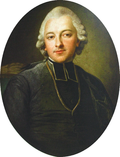 |
| Ignacy Krasicki |
The fable is
an ancient literary genre, often (though not invariably) set in verse. It is a
succinct story that features anthropomorphized animals, plants, inanimate
objects, or forces of nature that illustrate a moral lesson (a
"moral"). Verse fables have used a variety of meter and rhyme
patterns.
Notable verse
fabulists have included Aesop, Vishnu Sarma, Phaedrus, Marie de France, Robert
Henryson, Biernat of Lublin, Jean de La Fontaine, Ignacy Krasicki, Félix María
de Samaniego, Tomás de Iriarte, Ivan Krylov and Ambrose Bierce.
Prose Poetry
 |
| Charles Baudelaire, by Gustave Courbet |
Prose poetry
is a hybrid genre that shows attributes of both prose and poetry. It may be
indistinguishable from the micro-story (a.k.a. the "short short
story", "flash fiction"). While some examples of earlier prose
strike modern readers as poetic, prose poetry is commonly regarded as having
originated in 19th-century France, where its practitioners included Aloysius
Bertrand, Charles Baudelaire, Arthur Rimbaud and Stéphane Mallarmé. Since the
late 1980s especially, prose poetry has gained increasing popularity, with
entire journals, such as The Prose Poem: An International Journal, Contemporary
Haibun Online and Modern Haibun & Tanka Prose devoted to that genre.
Speculative Poetry
Speculative
poetry, also known as fantastic poetry, (of which weird or macabre poetry is a
major subclassification), is a poetic genre which deals thematically with
subjects which are 'beyond reality', whether via extrapolation as in science
fiction or via weird and horrific themes as in horror fiction. Such poetry
appears regularly in modern science fiction and horror fiction magazines. Edgar
Allen Poe is sometimes seen as the "father of speculative poetry".
Adapted from en.wikipedia.org
Adapted from en.wikipedia.org

 Facebook

0 comments:
Post a Comment