Drama is the specific mode of fiction represented in performance. The term comes from a Greek word meaning "action" (Classical Greek: δρᾶμα, drama), which is derived from "to do","to act" (Classical Greek: δράω, draō). The enactment of drama in theatre, performed by actors on a stage before an audience, presupposes collaborative modes of production and a collective form of reception. The structure of dramatic texts, unlike other forms of literature, is directly influenced by this collaborative production and collective reception. The early modern tragedy Hamlet (1601) by Shakespeare and the classical Athenian tragedy Oedipus the King (c. 429 BCE) by Sophocles are among the masterpieces of the art of drama. A modern example is Long Day's Journey into Night by Eugene O’Neill (1956).
The two masks
associated with drama represent the traditional generic division between comedy
and tragedy. They are symbols of the ancient Greek Muses, Thalia and Melpomene.
Thalia was the Muse of comedy (the laughing face), while Melpomene was the Muse
of tragedy (the weeping face). Considered as a genre of poetry in general, the
dramatic mode has been contrasted with the epic and the lyrical modes ever
since Aristotle's Poetics (c. 335 BCE)—the earliest work of dramatic theory.
The use of
"drama" in the narrow sense to designate a specific type of play
dates from the 19th century. Drama in this sense refers to a play that is
neither a comedy nor a tragedy—for example, Zola's Thérèse Raquin (1873) or
Chekhov's Ivanov (1887). It is this narrow sense that the film and television
industry and film studies adopted to describe "drama" as a genre
within their respective media. "Radio drama" has been used in both
senses—originally transmitted in a live performance, it has also been used to
describe the more high-brow and serious end of the dramatic output of radio.
Drama is
often combined with music and dance: the drama in opera is generally sung
throughout; musicals generally include both spoken dialogue and songs; and some
forms of drama have incidental music or musical accompaniment underscoring the
dialogue (melodrama and Japanese Nō, for example). In certain periods of
history (the ancient Roman and modern Romantic) some dramas have been written
to be read rather than performed. In improvisation, the drama does not
pre-exist the moment of performance; performers devise a dramatic script
spontaneously before an audience.
History of
Western Drama
Classical
Athenian drama
Western drama
originates in classical Greece. The theatrical culture of the city-state of
Athens produced three genres of drama: tragedy, comedy, and the satyr play.
Their origins remain obscure, though by the 5th century BCE they were
institutionalised in competitions held as part of festivities celebrating the
god Dionysus. Historians know the names of many ancient Greek dramatists, not
least Thespis, who is credited with the innovation of an actor
("hypokrites") who speaks (rather than sings) and impersonates a
character (rather than speaking in his own person), while interacting with the
chorus and its leader ("coryphaeus"), who were a traditional part of
the performance of non-dramatic poetry (dithyrambic, lyric and epic). Only a
small fraction of the work of five dramatists, however, has survived to this
day: we have a small number of complete texts by the tragedians Aeschylus,
Sophocles and Euripides, and the comic writers Aristophanes and, from the late
4th century, Menander. Aeschylus' historical tragedy The Persians is the oldest
surviving drama, although when it won first prize at the City Dionysia
competition in 472 BCE, he had been writing plays for more than 25 years. The
competition ("agon") for tragedies may have begun as early as 534
BCE; official records ("didaskaliai") begin from 501 BCE, when the
satyr play was introduced. Tragic dramatists were required to present a tetralogy
of plays (though the individual works were not necessarily connected by story
or theme), which usually consisted of three tragedies and one satyr play
(though exceptions were made, as with Euripides' Alcestis in 438 BCE). Comedy
was officially recognised with a prize in the competition from 487 to 486 BCE.
Five comic dramatists competed at the City Dionysia (though during the
Peloponnesian War this may have been reduced to three), each offering a single
comedy. Ancient Greek comedy is traditionally divided between "old
comedy" (5th century BCE), "middle comedy" (4th century BCE) and
"new comedy" (late 4th century to 2nd BCE).
Roman Drama
Following the
expansion of the Roman Republic (509–27 BCE) into several Greek territories
between 270–240 BCE, Rome encountered Greek drama. From the later years of the
republic and by means of the Roman Empire (27 BCE-476 CE), theatre spread west
across Europe, around the Mediterranean and reached England; Roman theatre was
more varied, extensive and sophisticated than that of any culture before it.
While Greek drama continued to be performed throughout the Roman period, the
year 240 BCE marks the beginning of regular Roman drama. From the beginning of
the empire, however, interest in full-length drama declined in favour of a
broader variety of theatrical entertainments. The first important works of
Roman literature were the tragedies and comedies that Livius Andronicus wrote
from 240 BCE. Five years later, Gnaeus Naevius also began to write drama. No
plays from either writer have survived. While both dramatists composed in both
genres, Andronicus was most appreciated for his tragedies and Naevius for his
comedies; their successors tended to specialise in one or the other, which led
to a separation of the subsequent development of each type of drama. By the
beginning of the 2nd century BCE, drama was firmly established in Rome and a
guild of writers (collegium poetarum) had been formed. The Roman comedies that
have survived are all fabula palliata (comedies based on Greek subjects) and
come from two dramatists: Titus Maccius Plautus (Plautus) and Publius Terentius
Afer (Terence). In re-working the Greek originals, the Roman comic dramatists
abolished the role of the chorus in dividing the drama into episodes and
introduced musical accompaniment to its dialogue (between one-third of the
dialogue in the comedies of Plautus and two-thirds in those of Terence). The
action of all scenes is set in the exterior location of a street and its
complications often follow from eavesdropping. Plautus, the more popular of the
two, wrote between 205 and 184 BCE and twenty of his comedies survive, of which
his farces are best known; he was admired for the wit of his dialogue and his
use of a variety of poetic meters. All of the six comedies that Terence wrote
between 166 and 160 BCE have survived; the complexity of his plots, in which he
often combined several Greek originals, was sometimes denounced, but his
double-plots enabled a sophisticated presentation of contrasting human
behaviour. No early Roman tragedy survives, though it was highly regarded in
its day; historians know of three early tragedians—Quintus Ennius, Marcus
Pacuvius and Lucius Accius. From the time of the empire, the work of two
tragedians survives—one is an unknown author, while the other is the Stoic
philosopher Seneca. Nine of Seneca's tragedies survive, all of which are fabula
crepidata (tragedies adapted from Greek originals); his Phaedra, for example,
was based on Euripides' Hippolytus. Historians do not know who wrote the only
extant example of the fabula praetexta (tragedies based on Roman subjects),
Octavia, but in former times it was mistakenly attributed to Seneca due to his
appearance as a character in the tragedy.
Medieval
In the Middle
Ages, drama in the vernacular languages of Europe may have emerged from
religious enactments of the liturgy. Mystery plays were presented on the porch
of the cathedrals or by strolling players on feast days. Miracle and mystery
plays, along with moralities and interludes, later evolved into more elaborate
forms of drama, such as was seen on the
Elizabethan
and Jacobean
One of the
great flowerings of drama in England occurred in the 16th and 17th centuries.
Many of these plays were written in verse, particularly iambic pentameter. In
addition to Shakespeare, such authors as Christopher Marlowe, Thomas Middleton,
and Ben Jonson were prominent playwrights during this period. As in the
medieval period, historical plays celebrated the lives of past kings, enhancing
the image of the Tudor monarchy. Authors of this period drew some of their
storylines from Greek mythology and Roman mythology or from the plays of
eminent Roman playwrights such as Plautus and Terence.
Modern and Postmodern
The pivotal
and innovative contributions of the 19th-century Norwegian dramatist Henrik
Ibsen and the 20th-century German theatre practitioner Bertolt Brecht dominate
modern drama; each inspired a tradition of imitators, which include many of the
greatest playwrights of the modern era. The works of both playwrights are, in
their different ways, both modernist and realist, incorporating formal
experimentation, meta-theatricality, and social critique. In terms of the
traditional theoretical discourse of genre, Ibsen's work has been described as
the culmination of "liberal tragedy", while Brecht's has been aligned
with an historicised comedy.
Other
important playwrights of the modern era include Antonin Artaud, August
Strindberg, Anton Chekhov, Frank Wedekind, Maurice Maeterlinck, Federico García
Lorca, Eugene O'Neill, Luigi Pirandello, George Bernard Shaw, Ernst Toller,
Vladimir Mayakovsky, Arthur Miller, Tennessee Williams, Jean Genet, Eugène
Ionesco, Samuel Beckett, Harold Pinter, Friedrich Dürrenmatt, Dario Fo, Heiner
Müller, and Caryl Churchill.
Asian drama
India
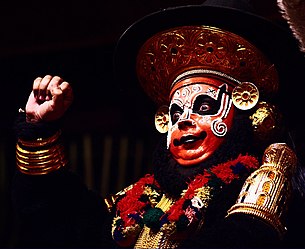
Performer
playing Sugriva in the Koodiyattam form of Sanskrit theatre.
The earliest
form of Indian drama was the Sanskrit drama. It began after the development of
Greek and Roman drama and before the development of theatre in other parts of
Asia. It emerged sometime between the 2nd century BCE and the 1st century CE
and flourished between the 1st century CE and the 10th, which was a period of
relative peace in the history of India during which hundreds of plays were
written. With the Islamic conquests that began in the 10th and 11th centuries,
theatre was discouraged or forbidden entirely.[35] Later, in an attempt to
re-assert indigenous values and ideas, village theatre was encouraged across
the subcontinent, developing in a large number of regional languages from the
15th to the 19th centuries.[36] Modern Indian theatre developed during the
period of colonial rule under the British Empire, from the mid-19th century
until the mid-20th.
Sanskrit
theatre
The
earliest-surviving fragments of Sanskrit drama date from the 1st century CE.
The wealth of archeological evidence from earlier periods offers no indication
of the existence of a tradition of theatre. The ancient Vedas (hymns from
between 1500 to 1000 BCE that are among the earliest examples of literature in
the world) contain no hint of it (although a small number are composed in a
form of dialogue) and the rituals of the Vedic period do not appear to have
developed into theatre. The Mahābhāṣya by Patañjali contains the earliest
reference to what may have been the seeds of Sanskrit drama. This treatise on
grammar from 140 BCE provides a feasible date for the beginnings of theatre in
India.
The major
source of evidence for Sanskrit theatre is A Treatise on Theatre (Nātyaśāstra),
a compendium whose date of composition is uncertain (estimates range from 200
BCE to 200 CE) and whose authorship is attributed to Bharata Muni. The Treatise
is the most complete work of dramaturgy in the ancient world. It addresses
acting, dance, music, dramatic construction, architecture, costuming, make-up,
props, the organisation of companies, the audience, competitions, and offers a
mythological account of the origin of theatre.
Its drama is
regarded as the highest achievement of Sanskrit literature. It utilised stock
characters, such as the hero (nayaka), heroine (nayika), or clown (vidusaka).
Actors may have specialised in a particular type. It was patronized by the
kings as well as village assemblies. Famous early playwrights include Bhasa,
Kalidasa (famous for Vikrama and Urvashi, Malavika and Agnimitra, and The
Recognition of Shakuntala), Śudraka (famous for The Little Clay Cart),
Asvaghosa, Daṇḍin, and Emperor Harsha (famous for Nagananda, Ratnavali and
Priyadarsika). Śakuntalā (in English translation) influenced Goethe's Faust
(1808–1832).
Modern Indian
drama
Rabindranath
Tagore, who was awarded the Nobel Prize for Literature in 1913, is probably
India's best-known modern playwright. His plays are written in Bengali and
include Chitra (Chitrangada, 1892), The King of the Dark Chamber (Raja, 1910),
The Post Office (Dakghar, 1913), and Red Oleander (Raktakarabi, 1924).
Modern Urdu
drama of India and Pakistan
Urdu Drama
evolved from the prevailing dramatic traditions of North India shaping Rahas or
Raas as practiced by exponents like Nawab Wajid Ali Shah of Awadh. His dramatic
experiments led to the famous Inder Sabha of Amanat and later this tradition
took the shape of Parsi Theatre. Agha Hashr Kashmiri is the culmination of this
tradition.
In some way
or other, Urdu theatre tradition has greatly influenced modern Indian theatre.
Among all the languages Urdu (which was called Hindi by early writers), along
with Gujrati, Marathi and Bengali theatres have kept flourishing and demand for
its writers and artists has not subsided by the drama aficionados. For Urdu
drama, no place is better than Bombay Film industry otherwise known as Hindi
film industry. All the early gems of Urdu Theatre (performed by Parsi
Companies) were made into films. Urdu Dramatic tradition has been a spectator’s
delight since 100 years and counting.
Drama as a
theme is made up of several elements. It focuses on life and different aspects
of it. The thing to be noticed here is that drama on stage imitates drama in
life. It has been said that, there has always been a mutual relationship
between theatre and real life. Great historical personalities like Shakespeare
have influenced Modern Urdu tradition to a large extent when Indian, Iranian,
Turkish stories and folk was adapted for stage with heavy doses of Urdu poetry.
In modern times writers like Imtiaz Ali Taj, Rafi Peer, Krishan Chander, Manto,
Upender Nath Ashk, Ghulam Rabbani, Prof. Mujeeb and many others shaped this
tradition.
While Prof
Hasan, Ghulam Jeelani, J.N,Kaushal, Shameem Hanfi, Jameel Shaidayi, etc. belong
to the old generation, contemporary writers like Danish Iqbal, Sayeed Alam,
Shahid Anwar, Iqbal Niyazi, and Anwar are a few postmodern playwrights actively
contributing in the field of Urdu Drama.
Sayeed Alam
is known for his wit and humour and more particularly for Plays like 'Ghalib in
New Delhi' 'Big B'and many other gems which are regularly staged for massive
turn out of theatre lovers. Maulana Azad is his magnum opus both for its
content and style.
Danish
Iqbal's play about 'Dara Shikoh' directed by M. S. Sathyu is considered a
modern classic for the use of newer theatre techniques and contemporary
perspective. His other plays are 'Sahir' on the famous lyricist and
revolutionary poet. 'Kuchh Ishq kiya Kuchh Kaam' is another play written by
Danish which is basically a Celebration of the Faiz's poetry, featuring events
from the early part of his life, particularly the events and incidents of pre-partition
days which shaped his life and ideals. 'Chand Roz Aur Meri Jaan' - another play
inspired from Faiz's letters written from various jails during the Rawalpindi
Conspiracy days. He has written 14 other plays including 'Dilli Jo Ek Shehr
Thaa' and 'Main Gaya Waqt Nahin hoon'. Shahid's 'Three B' is also a significant
play. He has been associated with many groups like 'Natwa' and others. Zaheer
Anwar has kept the flag of Urdu theatre flying in Kolkata. Unlike the writers
of previous generation Sayeed, Shahid, Danish Iqbal and Zaheer do not write
bookish plays but their work is a product of vigorous performing tradition.
Iqbal Niyazi of Mumbai has written several plays in Urdu, his play "AUR
KITNE JALYANWALA BAUGH?" won a National award other awards. Hence this is
the only generation after Amanat and Agha Hashr who actually write for stage
and not for libraries.
China
Chinese
theatre has a long and complex history. Today it is often called Chinese opera
although this normally refers specifically to the popular form known as Beijing
Opera and Kunqu; there have been many other forms of theatre in China.
Japan
Japanese Nō
drama is a serious dramatic form that combines drama, music, and dance into a
complete aesthetic performance experience. It developed in the 14th and 15th
centuries and has its own musical instruments and performance techniques, which
were often handed down from father to son. The performers were generally male
(for both male and female roles), although female amateurs also perform Nō
dramas. Nō drama was supported by the government, and particularly the
military, with many military commanders having their own troupes and sometimes
performing themselves. It is still performed in Japan today.
Kyōgen is the
comic counterpart to Nō drama. It concentrates more on dialogue and less on
music, although Nō instrumentalists sometimes appear also in Kyōgen. Kabuki
drama, developed from the 17th century, is another comic form, which includes
dance.
Forms of
drama
Opera
Western opera
is a dramatic art form, which arose during the Renaissance in an attempt to
revive the classical Greek drama tradition in which both music and theatre were
combined. Being strongly intertwined with western classical music, the opera
has undergone enormous changes in the past four centuries and it is an
important form of theatre until this day. Noteworthy is the huge influence of
the German 19th century composer Richard Wagner on the opera tradition. In his
view, there was no proper balance between music and theatre in the operas of
his time, because the music seemed to be more important than the dramatic
aspects in these works. To restore the connection with the traditional Greek
drama, he entirely renewed the operatic format, and to emphasize the equal
importance of music and drama in these new works, he called them "music
dramas".
Chinese opera
has seen a more conservative development over a somewhat longer period of time.
Pantomime
These stories
follow in the tradition of fables and folk tales. Usually there is a lesson
learned, and with some help from the audience, the hero/heroine saves the day.
This kind of play uses stock characters seen in masque and again commedia
dell'arte, these characters include the villain (doctore), the clown/servant
(Arlechino/Harlequin/buttons), the lovers etc. These plays usually have an
emphasis on moral dilemmas, and good always triumphs over evil, this kind of
play is also very entertaining making it a very effective way of reaching many
people.
Creative
drama
Creative
drama includes dramatic activities and games used primarily in educational
settings with children. Its roots in the United States began in the early
1900s. Winifred Ward is considered to be the founder of creative drama in
education, establishing the first academic use of drama in Evanston, Illinois.
Legal status
UK
The
Copyright, Designs and Patents Act 1988 does not define a dramatic work except
to state that it includes a work of dance or mime. However, it is clear that
dramatic work includes the scenario or script for films, plays (written for
theatre, cinema, television or radio). and choreographic works.
Adapted from en.wikipedia.org

 Facebook

0 comments:
Post a Comment